
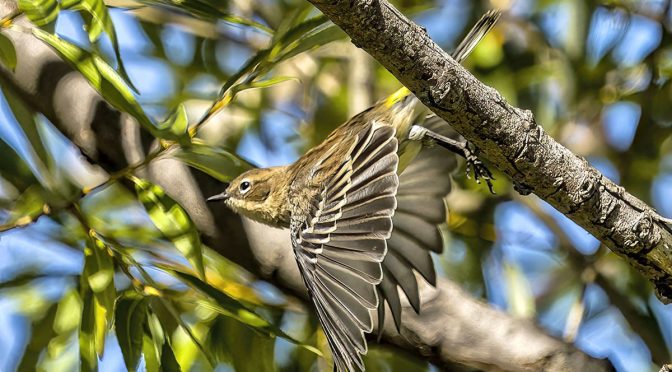
It can be difficult to photograph birds buried in branches, especially smaller subjects that don’t give us much of an auto-focus target.
NOTE: Click on images to enlarge. To view this article in a range of languages click on the Canadian flag in the upper right corner.
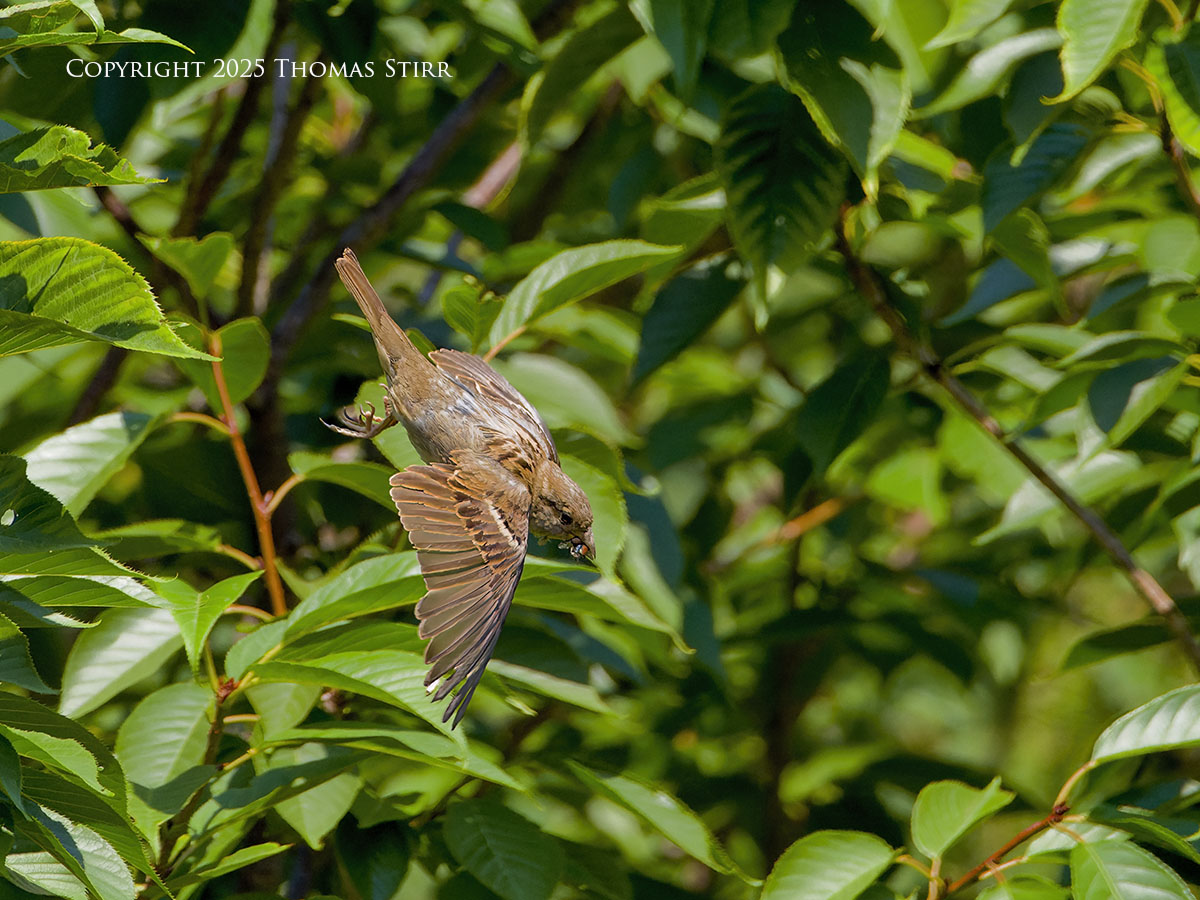
If we can develop an easy-to-use technique, not only can we photograph birds perched and buried in branches, but we can also capture them taking flight from obscured positions.
A good example is the Eastern Rosella in the next four frames.

You can see the bird is visually obscured by some branches and buds. There was a small portion of the rosella’s flank that was exposed enough for me to place a single, small auto-focus point on it.

The image above captures the rosella five frames later as it took flight from the obscured position.

Then, six frames later the rosella is captured in mid-air as it is taking full flight.

The photograph above is the last one in my fifteen frame Pro Capture H run, shot at 60 frames-per-second. My Pre-Shutter Frames and Frame Limiter were both set to 15. This gave me a 1/4 second of shutter release response time.
These Eastern Rosella images illustrate a very easy-to-use technique that can consistently produce interesting images of small birds taking flight from obscured positions.

Obviously step 1 is to find a bird buried in branches.

Step 2 is to place a single, small auto-focus point on any part of the bird’s body that is visible through the branches.

Step 3 is to anticipate the direction that the bird will move as it takes flight, or hops to another position. Birds will typically fly towards an open area, and they will signal that movement direction by where their beak is pointing.

Step 4 is timing your shutter release to coincide with the action that you want to photograph. If your camera has Pro Capture H technology (or something similar in other brands of camera) you can spool images into temporary memory by half depressing your shutter release… then fully depress your shutter release when the bird has completed the action you wanted to capture.

When photographing birds buried in branches I always use single auto-focus… with one, small auto-focus point. I find this is much more reliable than using continuous auto-focus, and risking my camera inadvertently focusing on branches in front of the subject bird as it reacquires auto-focus between each frame.

Everyone has their preferred compositional approach. I like capturing birds buried in branches as it adds more environmental context and realism to my images.

I typically photograph birds buried in branches that are flitting or hopping between branches. Using a fast frame rate helps me capture at least some frames with unobstructed views of a subject bird’s head.

Even short distance hops can often yield very interesting body positions.

Photographing small birds in amongst branches and twigs does complicate the image capture approach. And… that makes it more challenging and fun.

Often I have to slowly approach birds buried in branches, and position myself at the precise spot where I can shoot through all kinds of obstructions in the foreground in order to capture my images.

Compared to many other photographers I probably spend a lot more time standing in close to trees waiting for small birds to arrive, and provide me with interesting image opportunities. This technique can also be used to capture butterflies taking flight when perched in amongst branches, twigs and blossoms.

To me, a bird in the bush is worth two in the hand.
Technical Note
Photographs were captured handheld using camera gear as noted in the EXIF data. All images were created from RAW files using my standard process in post. This is the 1,506 article published on this website since its original inception in 2015.
How you can keep this website advertising free
My intent is to keep this photography blog advertising free. If you enjoyed this article and/or my website and would like to support my work, you can purchase an eBook, or make a donation through PayPal (see Donate box below). Both are most appreciated.
You may enjoy bird photography, and if so our 188 page eBook Handheld Bird Photography may be of interest. It is available for download for an investment of $14.99 CDN. The best viewing experience of this eBook will be at 100% using Adobe Acrobat Reader.
Sometimes all we need as photographers is a bit of inspiration. We hope you can find some of that inside Finding Visual Expression II.

Finding Visual Expression II is available for download for an investment of $11.99 CDN. The best viewing experience of this eBook will be at 100% using Adobe Acrobat Reader.
You may be interested in all of the 30 concepts covered in both of these related eBooks. If so, you may want to also consider Finding Visual Expression.

Finding Visual Expression is available for download for an investment of $11.99 Cdn. The best viewing experience of this eBook will be at 100% using Adobe Acrobat Reader.
Our other eBooks include Images of Ireland, New Zealand Tip-to-Tip, Nikon 1: The Little Camera That Could, Desert & Mountain Memories, Images of Greece, Nova Scotia Photography Tour, and a business leadership parable… Balancing Eggs.
If you click on the Donate button below you will find that there are three donation options: $7.50, $10.00 and $20.00. All are in Canadian funds. Plus, you can choose a different amount if you want. You can also increase your donation amount to help offset our costs associated with accepting your donation through PayPal. An ongoing, monthly contribution to support our work can also be done through the PayPal Donate button below.
You can make your donation through your PayPal account, or by using a number of credit card options.
Word of mouth is the best form of endorsement. If you like our website please let your friends and associates know about our work. Linking to this site or to specific articles is allowed with proper acknowledgement. Reproducing articles, or any of the images contained in them, on another website or in any social media posting is a Copyright infringement.
Article is Copyright 2026 Thomas Stirr. Photographs are Copyright 2022-2025 Thomas Stirr. All rights reserved. No use, duplication or adaptation of any kind is allowed without written consent. If you see this article reproduced anywhere else it is an unauthorized and illegal use. Posting comments on offending websites and calling out individuals who steal intellectual property is always appreciated!
Very wonderful article as I would have never thought of using ProCapture in this fashion but I will try it as I live in Maine and I have a lot of branches in the way! I have a Om-1MKII with the 100-400mm II lens and have trouble using single point AF so I use the small area. Between reading this article and your newest e-book on hand-held bird photography (I am 1/2 way through it), I am tempted to get the 150-600 as I would like to have a bit more reach at times but I worry about the weight but is seems like you don’t think it is a problem. I will rent it this Spring and see if I can deal with the weight. I have learned a lot from your articles and I appreciate your effort and candor. Keep up the good work. I am going to use a new email address as my old one is going to be deactivated this year.
Hi John,
The M.Zuiko 150-600 is noticeably larger and heavier than the 100-400 so renting one to try it out is a prudent thing to do. I find that my Cotton Carrier harnesses are invaluable to take the weight off my arms when I’m not actively shooting. I imagine that the small area AF on the OM-1 MKII is probably close to the size of a single AF point with my E-M1X.
Tom
Excellent article, showing it’s all about technique rather than the gear.
With an OM camera with bird detection would you have that running in the background along with the small single point focus?
I find your articles so informative and have recommended to fellow Olympus users.
Hi Andrew,
For these types of photographs.. capturing images of birds that are visually obstructed… I would never use Bird Detection AI as there would be no logical reason to use this technology. When using a very fast frame rate a bird would not be able to move far enough to move out of focus. That’s why I use Single AF, rather than Continuous AF.
If I owned an OM-1 camera, I would use single AF, with a single AF point (or a very small grouping given the number of AF points on the sensor) and use a frame rate of 120 frames-per-second. When I do a Pro Capture H run I’m looking for a select number of precise image captures. I really don’t care if I need to throw away most of the images from that run.
But, that’s just me… other folks would use an OM-1 differently than I likely would.
Tom
Hi!
Sorry for German, but I cannot copy/paste from a translator.
Ich möchte mich anschliessen, ein sehr interessanter Artikel. Auch ich liebe es, die Vögel mit ihrer Umgebung zu zeigen. Ihre Flugkünste sind besonders in Sträuchern und Baumkronen zu bewundern!
Aufgrund Ihrer Webseite habe ich mich kürzlich für eine OM-1MII entschieden und lerne seither jedes Mal dazu.
Letzthin habe ich ProCapSH2 mit Bird-AF und C-AF, Cross-AF gearbeitet. Es sind ein paar wenige Treffer gelungen.
Als nächstes versuche ich mich mit meinem Nikon 300/f4 in M-AF, ProCapSH1 (120fps, 60/60 = 1/2sec.) und folge damit Ihrer Technik. Vielen Dank für die Anregungen!
BR, Peter
I’d like to chime in; this is a very interesting article. I also love photographing birds in their natural habitat. Their aerial skills are particularly impressive in bushes and treetops!
Thanks to your website, I recently decided to buy an OM-1 Mark II and have been learning something new every time I use it.
I recently tried ProCapSH2 with Bird AF and Continuous AF, Cross AF. I managed to get a few good shots.
Next, I’ll try ProCapSH1 with my Nikon 300mm f/4 in Manual AF (120fps, 60/60 = 1/2 sec.) and follow your technique. Thank you for the inspiration!
Best regards, Peter
Hi Peter,
I’m glad you are finding the website of benefit!
Any time that we move over to a new brand there is a learning curve. It took me a fair amount of time and practice before I felt confident with my Olympus (now OM) kit. I’ve never used an OM-1 or OM-1 Mark II so I can’t comment on those cameras. I’m not sure how much functionality you may lose using your Nikon full frame lenses on an OM-1 Mark II body.
Tom
Hallo Peter,
freut mich, dass dir die Website gefällt!
Jeder Wechsel zu einer neuen Marke erfordert etwas Einarbeitungszeit. Ich brauchte auch einige Zeit und Übung, bis ich mich mit meiner Olympus-Ausrüstung (jetzt OM) sicher fühlte. Ich habe weder eine OM-1 noch eine OM-1 Mark II benutzt, daher kann ich dazu nichts sagen. Ich bin mir nicht sicher, wie viele Funktionen du einbüßen würdest, wenn du deine Nikon-Vollformatobjektive an einer OM-1 Mark II verwendest.
Tom
Superb piece Tom the technique is first class and the results demonstrate the details perfectly.
It’s something I have never tried on my EM1-x and the 100-400. I will once this crazy neuropathy calm a bit! Another good piece and as always superb shots and colours
Hi Mark,
I’m glad that you enjoyed the images and found the approach in the article to be of interest.
Tom
Great article, so impressed with your images from 75-300. So many complain about that lens.
Hi Steve,
I’m glad you enjoyed the images. The M.Zuiko 75-300 f/4.8-6.7 II is a quite a good lens for its price, especially in good light. It does struggle to achieve focus in low light conditions.
Tom