
Advancements in photographic technology are making it increasingly important for us to view our camera equipment as part of an integrated imaging system. We need to look well beyond simplistic assessments of cameras, based primarily on sensor size. It is true that the sensor inside a camera is an important component that contributes to its photographic capabilities, but technology brings so much more to the table for us to consider.

Composing with Partial Reveals
This article features a small selection of images that illustrate composing with partial reveals. All were captured handheld during a recent, brief visit to the Niagara Parks Botanical Gardens. Continue reading Composing with Partial Reveals
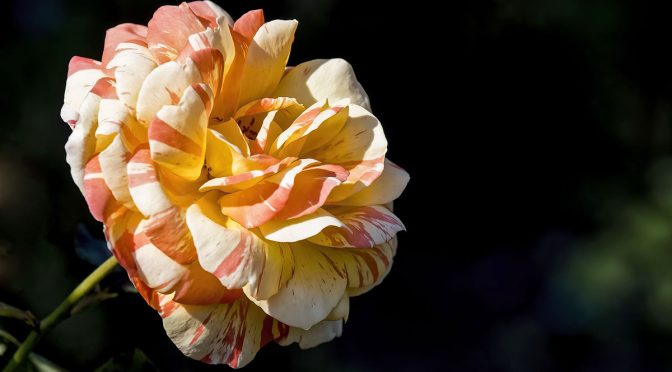
Niagara Parks Botanical Gardens
Last week my wife and I made a very quick visit to the Niagara Parks Botanical Gardens. This article features a selection of flower and foliage images that I captured during our short visit.

Minimum Focusing Distance
One of the attributes of a lens that is sometimes overlooked is its minimum focusing distance. There are many important factors to consider when investing in a new lens such as focal length, aperture, lens construction/weatherproofing, sharpness and colour rendition. So, it is not surprising that minimum focusing distance is sometimes not given much consideration.
M.Zuiko 75-300 Assessment
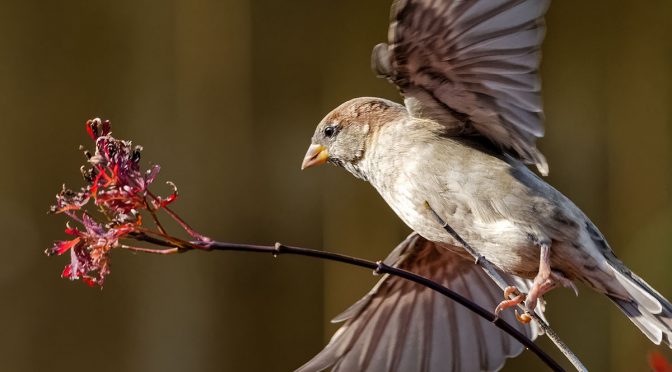
This article provides a summary of a number of points made in earlier articles and provides an overall M.Zuiko 75-300 assessment. Since some folks seem to focus on what this lens isn’t, I might as well state that right up front. This lens isn’t weatherproof and it isn’t designated as a pro lens. What this lens is in spades… is small, lightweight, cost efficient, and a whole lotta fun to use!

M.Zuiko 75-300 with Extension Tube
This article features some photographs captured with the M.Zuiko 75-300 f/4.8-6.7 II with a Kenko 16 mm M4/3 extension tube. It is getting late in our season to photograph insects and flowers, but I thought this would be an interesting final field test of the M.Zuiko 75-300 mm f/4.8-6.7 II telephoto zoom lens. Given the risks, I have not used my camera gear in any indoor, public venues since February.

M.Zuiko 75-300 Severe Crop Images
This article features a number of M.Zuiko 75-300 severe crop images of a sparrow in flight. Photographs were cropped to between 2000 and 2660 pixels on the width. This degree of cropping results in photographs that only utilize between 14.9% and 26.5% of the total number of available pixels on the sensor of my Olympus OM-D E-M1X (i.e. 5184 x 3888) being used for the subject bird.

M.Zuiko 75-300 Pro Capture
This article features an M.Zuiko 75-300 II Pro Capture H image run of a sparrow taking flight. This sequence was shot with the M.Zuiko 75-300 mm f/4.8-6.7 II wide open at f/6.7, and with the lens fully extended to 300 mm (efov 600 mm). A shutter speed of 1/2500 was used, along with ISO-1600 (Auto-ISO setting used). Exposure compensation was set to -0.7 step. I was situated 4.3 metres (~14 feet) away from the subject bird.
M.Zuiko PRO Lens Comparison
This article does an M.Zuiko PRO lens comparison with various Nikkor lenses. To arrive at the best comparisons that I could, the same apertures and equivalent fields-of-view were used where possible. All equivalent field-of-views noted are based on comparisons to a full frame camera format. Obviously there are not exact matches for all of the lenses between these two brands and formats. This is not a performance comparison. It is one based primarily on price, size, and weight.
One of the reasonably common comments expressed in online photography chat rooms is that Olympus M.Zuiko PRO lenses are ‘expensive’. This begs the question, “Compared to what?”

Good Looking Gulls
This article shares a selection of ‘good looking gulls’. These photographs were captured as part of our initial field testing of the M.Zuiko 75-300 mm f/4.8-6.7 II telephoto zoom lens. We recently added this lens to our Olympus kit.