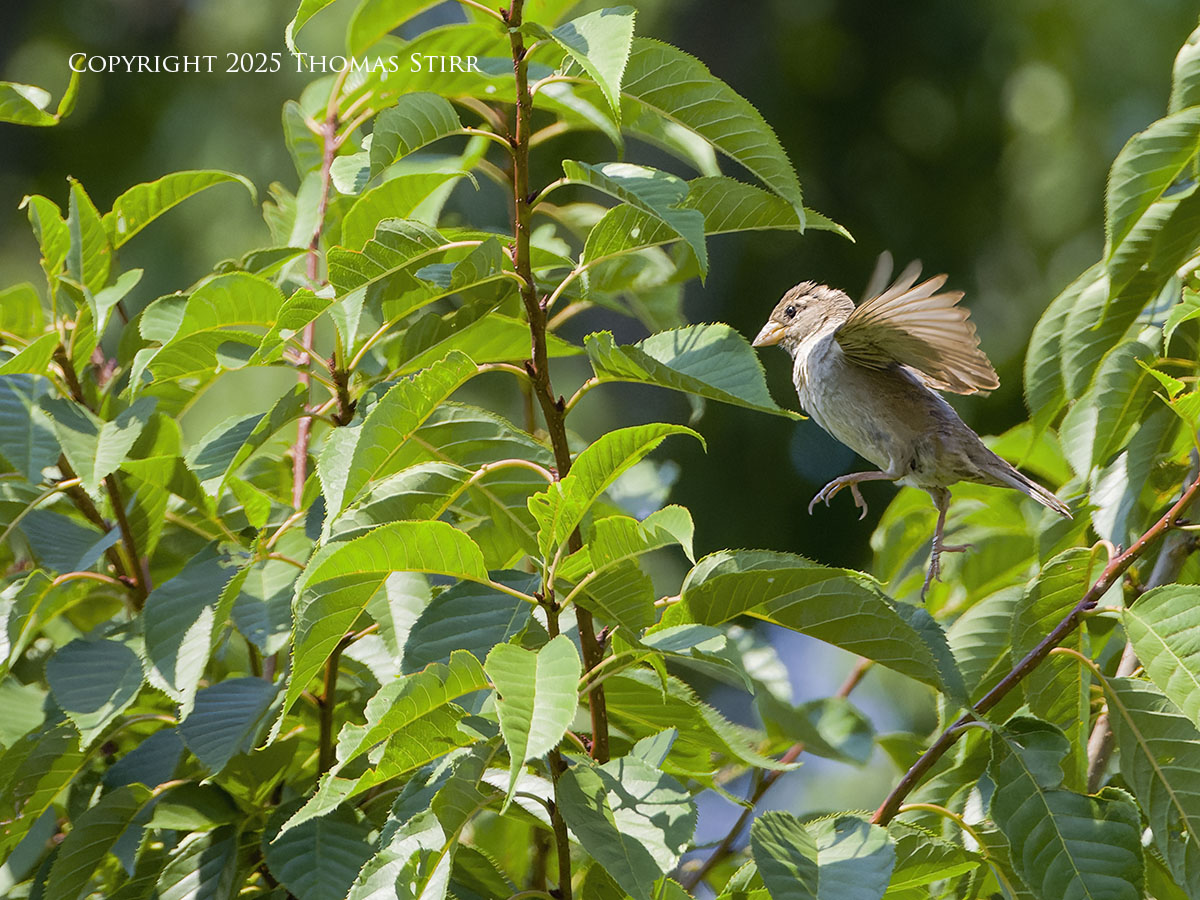
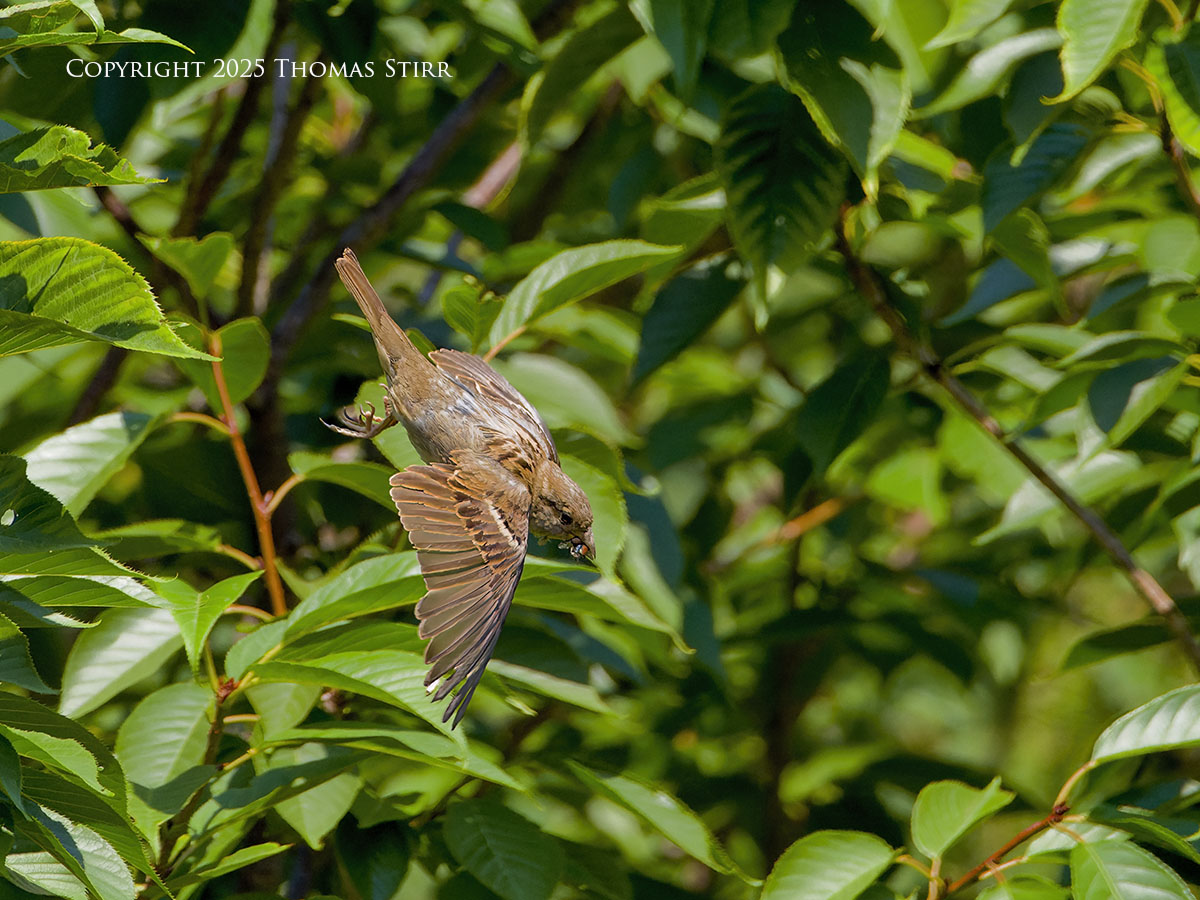
One of the challenges that I enjoy is photographing small BIF (birds-in-flight) in their environments, especially when amongst tree branches and other potential obstructions. Even very common birds like sparrows can take on an added dimension when capturing them in-flight in these situations.
NOTE: Click on images to enlarge. To view this article in a range of other languages click on the Canadian flag in the upper right corner.
OM-D E-M1 Mark III + M.Zuiko 75-300 mm f/4.8-6.7 II @ 300 mm, efov 600 mm, f/7.1, -0.7 EV, 1/2500, ISO-2000, Pro Capture H, cropped to 2882 pixels on the width, subject distance 14.4 metres
Advances in computational photography technologies with functions like Pro Capture L and H, and Bird Detection Subject Tracking AI, have significantly expanded what is possible for modern bird photography.
OM-D E-M1 Mark III + M.Zuiko 75-300 mm f/4.8-6.7 II @ 300 mm, efov 600 mm, f/7.1, 1/2500, ISO-3200, Pro Capture H, cropped to 3089 pixels on the width, subject distance 14 metresOM-D E-M1X + M.Zuiko 75-300 mm f/4.8-6.7 II @ 300 mm, efov 600 mm, 1/2500, f/6.7, ISO-1000, cropped to 3585 pixels on the width, Pro Capture H, subject distance 11.1 metres, GPS: S 37 32 59.364 E 175 55 13.079
Locating small bird amongst foliage can lead to interesting action images, enabled with some eye/hand coordination and appropriate shutter release timing.
OM-D E-M1X + M.Zuiko 75-300 mm f/4.8-6.7 II @ 300 mm, efov 600 mm, 1/2500, f/6.7, ISO-2000, cropped to 3702 pixels on the width, Pro Capture H, subject distance 14.9 metres, GPS: S 37 32 44.7 E 175 55 12.2639
Combining computational photography technologies like Pro Capture L and Bird Detection AI Subject Tracking increase the odds of capturing birds like kingfishers ‘on the wing’.
OM-D E-M1X + M.Zuiko 100-400 mm f/5-6.3 IS @ 400 mm, efov 800 mm, f/6.3, 1/2000, ISO-400, Pro Capture L, Bird Detection AI, cropped to 2417 pixels on the width, subject distance 37.7 metresOM-D E-M1X + M.Zuiko 100-400 mm f/5-6.3 IS with M.Zuiko MC-14 teleconverter @ 545 mm, efov 1090 mm, f/9, 1/2000, ISO-640, Pro Capture L, Bird Detection AI Subject Tracking, cropped to 1801 pixels on the widthOM-D E-M1X + M.Zuiko 100-400 mm f/5-6.3 IS with M.Zuiko MC-14 teleconverter @ 560 mm, efov 1120 mm, f/9, 1/2500, ISO-640, Bird Detection AI Subject Tracking, Pro Capture L, cropped to 2808 pixels on the width, subject distance 36 metresOM-D E-M1X + M.Zuiko 100-400 mm f/5-6.3 IS with MC-14 teleconverter @ 235 mm, efov 470 mm, f/8.3, 1/1600, ISO-500, Pro Capture L, Bird Detection AI Subject Tracking, cropped to 2494 pixels on the width, subject distance 25.4 metresOM-D E-M1X + M.Zuiko 100-400 mm f/5-6.3 IS @ 361 mm, efov 722 mm, f/6.3, 1/2000, ISO-640, Pro Capture L, Bird Detection AI, cropped to 2062 pixels on the width, subject distance 35.6 metres
And, computational technology can instill a high degree of confidence when photographing kingfishers launching into flight when using Pro Capture H, with a single, small auto-focus point.
OM-D E-M1X + M.Zuiko 150-600 mm f/5-6.3 IS @ 600 mm, efov 1200 mm, f/6.3, 1/2500, ISO-500, cropped to 2500 pixels on the width, Pro Capture H, subject distance 63 metresOM-D E-M1X + M.Zuiko 150-600 mm f/5-6.3 IS @ 600 mm, efov 1200 mm, f/6.3, 1/2500, ISO-640, cropped to 2596 pixels on the width, Pro Capture H, subject distance 55.7 metresOM-D E-M1X + M.Zuiko 150-600 mm f/5-6.3 IS @ 600 mm, efov 1200 mm, f/6.3, 1/2500, ISO-2500, Pro Capture H, cropped to 3172 pixels on the width, subject distance 31 metresOM-D E-M1X + M.Zuiko 100-400 mm f/5-6.3 IS @ 300 mm, efov 600 mm, f/6.3, 1/2500, ISO-250, Pro Capture L, Bird Detection AI Subject Tracking, cropped to 3700 pixels on the width, subject distance 9.8 metres
Pre-focusing telephoto lenses near nesting boxes can help capture images of fast flying birds like purple martins arriving back with their catch.
OM-D E-M1X + M.Zuiko 100-400 mm f/5-6.3 IS @ 400 mm, efov 800 mm, f/6.3, 1/3200, ISO-2500, Pro Capture H, cropped to 2903 pixels on the width, subject distance 17.4 metres
Small birds that are somewhat distant can be captured in flight using fast frame rates, and without needing to use continuous auto-focus.
OM-D E-M1X + M.Zuiko 100-400 mm f/5-6.3 IS @ 400 mm, efov 800 mm, f/6.3, 1/3200, ISO-2500, Pro Capture H, cropped to 2901 pixels on the width, subject distance 17.4 metres
As we can see in the next three images, capturing some less common in-flight behaviours like swallows diving on the surface of ponds are made possible with computational photography technologies like Pro Capture L in combination with Bird Detection AI Subject Tracking.
OM-D E-M1X + M.Zuiko 100-400 mm f/5-6.3 IS @ 400 mm, efov 800 mm, f/8, 1/4000, ISO-3200, Pro Capture L, Bird Detection AI Subject Tracking, cropped to 1999 pixels on the width, subject distance 46.2 metresOM-D E-M1X + M.Zuiko 100-400 mm f/5-6.3 IS @ 400 mm, efov 800 mm, f/8, 1/4000, ISO-2500, Pro Capture L, Bird Detection AI Subject Tracking, cropped to 2006 pixels on the width, subject distance 40 metresOM-D E-M1X + M.Zuiko 100-400 mm f/5-6.3 IS @ 400 mm, efov 800 mm, f/8, 1/4000, ISO-1250, Pro Capture L, Bird Detection AI Subject Tracking, cropped to 1999 pixels on the width, subject distance 25.8 metres
I love finding birds perched on the inside of trees and bushes… then capturing images of them taking flight.
OM-D E-M1X + M.Zuiko 100-400mm f/5-6.3 IS @ 400mm, f/6.3, 1/2500, ISO-1250, cropped to 3510 pixels on the width, Pro Capture H, subject distance 14.7 metres
The technique I use is quite simple. I use Pro Capture H with Pre-Shutter Frames and Frame Limiter both set to 15, and a frame rate of 60 frames-per-second. These settings give me 1/4 of a second of shutter release response time, which is more than adequate for my physical abilities, and style of photography.
OM-D E-M1X + M.Zuiko 150-600 mm f/5-6.3 IS @ 600 mm, efov 1200 mm, f/6.3, 1/2500, ISO-1000, cropped to 3707 pixels on the width, Pro Capture H, subject distance 21.1 metresOM-D E-M1X + M.Zuiko 100-400 mm f/5-6.3 IS @ 400 mm, efov 800 mm, f/6.3, 1/2500, ISO-3200, Pro Capture H, cropped to 3852 pixels on the width, subject distance 14.9 metresOM-D E-M1X + M.Zuiko 100-400 mm f/5-6.3 IS @ 400 mm, efov 800 mm, f/6.3, 1/2500, ISO-2000, Pro Capture H, cropped to 2979 pixels on the width, subject distance 16.9 metresOM-D E-M1X + M.Zuiko 100-400 mm f/5-6.3 IS @ 400 mm, efov 800 mm, 1/2500, f/6.3, -0.7 EV, ISO-6400, Pro Capture H, cropped to 3335 pixels on the width, subject distance 18 metresOM-D E-M1X + M.Zuiko 100-400 mm f/5-6.3 IS @ 400 mm, efov 800 mm, f/6.3, 1/2500, ISO-1000, Pro Capture H, cropped to 3212 pixels on the width, subject distance 14.2 metresOM-D E-M1X + M.Zuiko 100-400 mm f/5-6.3 IS with M.Zuiko MC-14 teleconverter @ 560 mm, efov 1120 mm, f/9, 1/1600, ISO-10000, Pro Capture H, full frame capture, subject distance 19 metresOM-D E-M1X + M.Zuiko 100-400 mm f/5-6.3 IS @ 400 mm, efov 800 mm, f/6.3, 1/2500, ISO-800, cropped to 2607 pixels on the width, Pro Capture H, subject distance 40.5 metresOM-D E-M1X + M.Zuiko 100-400 mm f/5-6.3 IS @ 400 mm, efov 800 mm, f/6.3, 1/2500, ISO-2500, Pro Capture H, cropped to 3337 pixels on the width, subject distance 9 metresOM-D E-M1X + M.Zuiko 100-400 mm f/5-6.3 IS @ 400 mm, efov 800 mm, f/6.3, 1/2500, ISO-6400, Pro Capture H, full frame capture, subject distance 17.1 metresOlympus OM-D E-M1X + M.Zuiko PRO 40-150 mm f/2.8 with M.Zuiko MC-20 Teleconverter @ 134 mm, efov 268 mm, f/5.6, 1/2000, ISO-640, subject distance 6.7 metres
Birds are creatures of habit and observing their behaviours in terms of preferred flight path direction and angles, can allow a photographer to anticipate action and set up accordingly.
Olympus OM-D E-M1X + M.Zuiko PRO 40-150 mm f/2.8 with MC-20 teleconverter @ 140 mm, efov 280 mm, f/5.6, 1/2500, ISO-6400, Pro Capture H mode
For example, waiting for a chickadee to come in for a landing to get some food.
Olympus OM-D E-M1X + M.Zuiko PRO 40-150 mm f/2.8 with MC-20 teleconverter @ 140 mm, efov 280 mm, f/5.6, 1/2500, ISO-6400, Pro Capture H modeOlympus OM-D E-M1X + M.Zuiko PRO 40-150 mm f/2.8 with MC-20 teleconverter @ 140 mm, efov 280 mm, f/5.6, 1/2500, ISO-6400, Pro Capture H mode
Or spooling temporary images of a pre-focused area waiting for a bird to fly into the frame.
OM-D E-M1X + M.Zuiko 100-400 mm f/5-6.3 IS @ 400 mm, efov 800 mm, f/6.3, 1/2500, ISO-1250, Pro Capture H, cropped to 3677 pixels on the width, subject distance 7 metres
Computational photography technologies have made it exponentially easier to capture images of small BIF.
OM-D E-M1X + M.Zuiko 100-400 mm f/5-6.3 IS with M.Zuiko MC-14 Teleconverter @ 560 mm, efov 1120 mm, f/9, 1/3200, ISO-2000, cropped to 3247 pixels on the width, Pro Capture H, subject distance 17.4 metres
Many of these incredible technological innovations have have only existed for the past six to eight years.
Olympus OM-D E-M1X + M.Zuiko PRO 40-150 mm f/2.8 with M.Zuiko MC-20 teleconverter @ 300 mm, efov 600 mm, f/5.6, 1/1600, ISO-500, Pro Capture H mode, subject distance 14.5 metres
During that time they have revolutionized the way that we capture images of small BIF.
Olympus OM-D E-M1X + M.Zuiko PRO 40-150 mm f/2.8 with M.Zuiko MC-20 teleconverter @ 300 mm, efov 600 mm, f/8, 1/4000, ISO-2000, Pro Capture H mode, subject distance 9.4 metres
We can now ‘push the envelope’ further than we ever dreamed possible in the past.
Olympus OM-D E-M1X + M.Zuiko PRO 40-150 mm f/2.8 and M.Zuiko MC-20 teleconverter @ 300 mm, efov 600 mm, f/5.6, 1/1600, ISO-2500, Pro Capture H Mode, subject distance 17.7 metres
If you own a camera that has computational photography technologies that you have not used… you are missing out on a lot of additional image potential and creative flexibility.
OM-D E-M1X + M.Zuiko 100-400 mm f/5-6.3 IS @ 400 mm, efov 800 mm, f/6.3, 1/5000, ISO-2500, Pro Capture H, cropped to 3122 pixels on the width, subject distance 16.9 metres
For many of us who have experienced the new creative pathways made possible by computational photography technologies… it is impossible to go back.
Technical Note
Photographs were captured handheld using camera gear as noted in the EXIF data. All images were created from RAW files using my standard process in post. This is the 1,495 article published on this website since its original inception in 2015.
How you can keep this website advertising free
My intent is to keep this photography blog advertising free. If you enjoyed this article and/or my website and would like to support my work, you can purchase an eBook, or make a donation through PayPal (see Donate box below). Both are most appreciated.
You may enjoy bird photography, and if so our 188 page eBook Handheld Bird Photography may be of interest. It is available for download for an investment of $14.99 CDN. The best viewing experience of this eBook will be at 100% using Adobe Acrobat Reader.
Sometimes all we need as photographers is a bit of inspiration. We hope you can find some of that insideFinding Visual Expression II.
Finding Visual Expression II is available for download for an investment of $11.99 CDN. The best viewing experience of this eBook will be at 100% using Adobe Acrobat Reader.
You may be interested in all of the 30 concepts covered in both of these related eBooks. If so, you may want to also considerFinding Visual Expression.
Finding Visual Expression is available for download for an investment of $11.99 Cdn. The best viewing experience of this eBook will be at 100% using Adobe Acrobat Reader.
If you click on the Donate button below you will find that there are three donation options: $7.50, $10.00 and $20.00. All are in Canadian funds. Plus, you can choose a different amount if you want. You can also increase your donation amount to help offset our costs associated with accepting your donation through PayPal. An ongoing, monthly contribution to support our work can also be done through the PayPal Donate button below.
You can make your donation through your PayPal account, or by using a number of credit card options.
Word of mouth is the best form of endorsement. If you like our website please let your friends and associates know about our work. Linking to this site or to specific articles is allowed with proper acknowledgement. Reproducing articles, or any of the images contained in them, on another website or in any social media posting is a Copyright infringement.
Article is Copyright 2025 Thomas Stirr. Images are Copyright 2021-2025 Thomas Stirr. All rights reserved. No use, duplication or adaptation of any kind is allowed without written consent. If you see this article reproduced anywhere else it is an unauthorized and illegal use. Posting comments on offending websites and calling out individuals who steal intellectual property is always appreciated!
2 thoughts on “Photographing Small BIF”
As always Tom another great piece. I haven’t tried the wonderful pro capture that is in our cameras. It looks very powerful and the image of the hand of food with the bird coming in is simply fantastic and a great shot.
I’m glad that you enjoyed the articles and the images. Pro Capture, both L and H, have significantly changed how I approach bird-in-flight photography.
This website celebrates the joy of photography and features a wide range of photographic subject matter. The content is designed to appeal to a wide range of people interested in photography. The website also demonstrates the image creating capability of small sensor cameras including micro four thirds, 1", and 1/2.3" cameras.
You cannot copy content of this page
We use cookies to ensure that we give you the best experience on our website. This is an advertising free website and we do not use any kind of advertising tracking cookies. Your email address or any other information you provide as your subscription to the website is never sold to any other party. If you subscribe to this website your email address is used to send out notifications on new articles. If you continue to use this site we will assume that you are happy with our approach to cookie use.




As always Tom another great piece. I haven’t tried the wonderful pro capture that is in our cameras. It looks very powerful and the image of the hand of food with the bird coming in is simply fantastic and a great shot.
Hi Mark,
I’m glad that you enjoyed the articles and the images. Pro Capture, both L and H, have significantly changed how I approach bird-in-flight photography.
Tom