

Observation skills are fundamental to all photographers, and are especially important to tune up prior to the bird spring migration season. Many of our best images stem from us being very aware of the environment around us.
NOTE: Click on images to enlarge. To view this article in a range of other languages click on the Canadian flag in the upper right corner.

Monitoring a heron slowly moving through shallow water, and watching for it to stop. Then stare intensely down at the surface of the water can be a precursor to it making a strike as it hunts for prey.

Watching the flight angle of a tern as it swoops in low over the surface of a pond can prepare us to capture images of it ‘skim fishing’.

Knowing that terns swallow their prey head first while they are in-flight allows us to anticipate that a tern flying with a fish crossways in its beak will need to adjust the position of the fish before feeding. This can create opportunities to photograph a tern retrieving a fish in mid-air.

Swallowing a fish head first is a common behaviour for many birds including herons.

Observing a heron with a fish in its bill is a precursor to it flipping the fish up and catching it in its bill head first so it can be swallowed.

Even smaller fish will need to be adjusted for a head first swallow.

Just before changing flight direction or slowing down in-flight, the tail feathers of a bird will be fanned out. Being observant allows us to better time our image captures.
Watching a tern in flight after diving for a fish can be instructive. Knowing that it will do a mid-air shake to dispel water from its feathers allows us to watch for a slight dip in its flying angle. This can help us time an image burst to capture the in-flight action.


Our observation skills coupled with a fast frame rate and good eye/hand coordination can result in capturing an interesting run of 7 images that happened in just over 1/3 of a second in total.
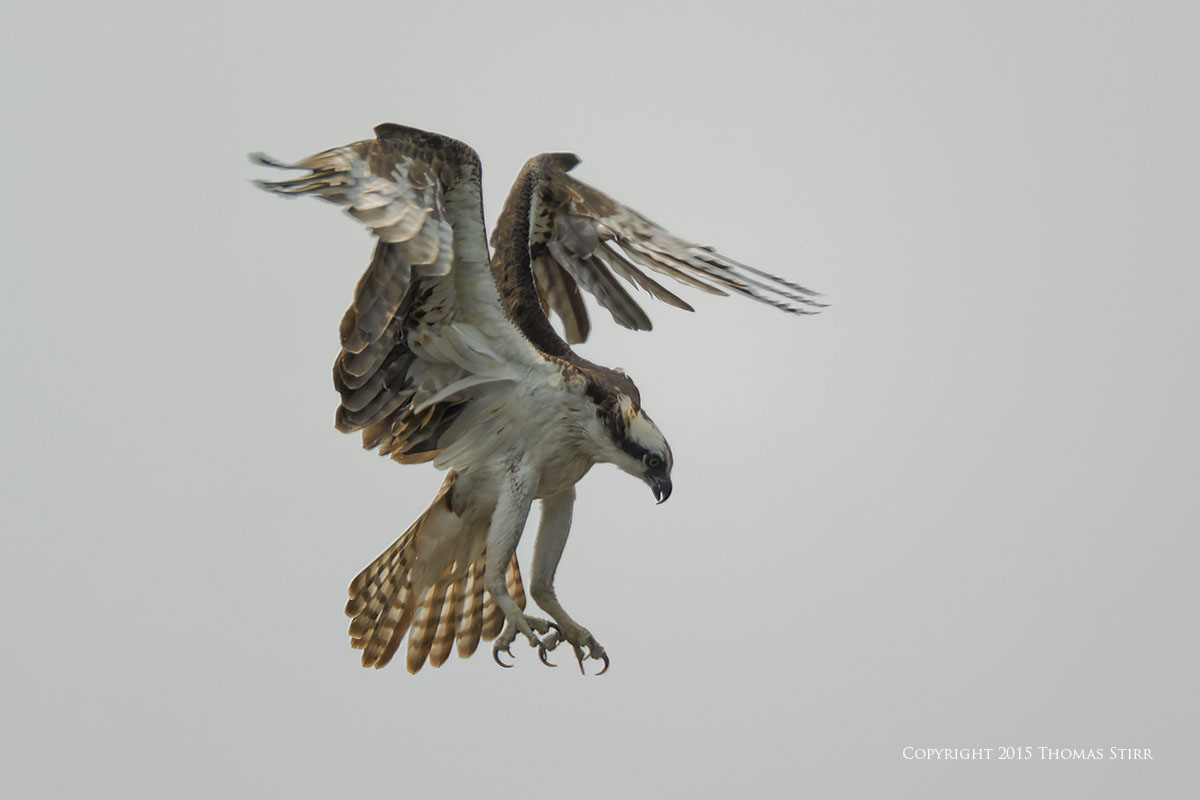
Being aware of when an osprey hovers and drops its talons down, can help us prepare to capture it diving down for a fish.

Monitoring how a mated pair of tree swallows enter and exit a nesting box can enable us to capture them in flight as they pass each other.

Observing that flight path that a specific tree swallow prefers when approaching its nesting box allows us to anticipate its flight direction. With Pro Capture H we can pre-focus our lens and spool images into temporary memory as we wait for the swallow to fly into our composition.

Small birds crouch slightly before launching into flight. Being aware of slight body movements can help us prepare to capture them as they launch into flight. Larger perched birds often defecate before taking off.

We can observe aggressive behaviours of individual birds, and anticipate interactions between species.

During the winter and the lulls that occur between bird migration seasons our observation skills can get a little rusty. Going out with our cameras isn’t just about capturing some images. Its also about tuning up our observation skills so we are better prepared to capture interesting action-oriented bird images.
Technical Note
Photographs were captured handheld using camera gear as noted in the EXIF data. All images were created from RAW files using my standard process in post. This is the 1,509 article published on this website since its original inception in 2015.
How you can keep this website advertising free
My intent is to keep this photography blog advertising free. If you enjoyed this article and/or my website and would like to support my work, you can purchase an eBook, or make a donation through PayPal (see Donate box below). Both are most appreciated.
You may enjoy bird photography, and if so our 188 page eBook Handheld Bird Photography may be of interest. It is available for download for an investment of $14.99 CDN. The best viewing experience of this eBook will be at 100% using Adobe Acrobat Reader.
Sometimes all we need as photographers is a bit of inspiration. We hope you can find some of that inside Finding Visual Expression II.

Finding Visual Expression II is available for download for an investment of $11.99 CDN. The best viewing experience of this eBook will be at 100% using Adobe Acrobat Reader.
You may be interested in all of the 30 concepts covered in both of these related eBooks. If so, you may want to also consider Finding Visual Expression.

Finding Visual Expression is available for download for an investment of $11.99 Cdn. The best viewing experience of this eBook will be at 100% using Adobe Acrobat Reader.
Our other eBooks include Images of Ireland, New Zealand Tip-to-Tip, Nikon 1: The Little Camera That Could, Desert & Mountain Memories, Images of Greece, Nova Scotia Photography Tour, and a business leadership parable… Balancing Eggs.
If you click on the Donate button below you will find that there are three donation options: $7.50, $10.00 and $20.00. All are in Canadian funds. Plus, you can choose a different amount if you want. You can also increase your donation amount to help offset our costs associated with accepting your donation through PayPal. An ongoing, monthly contribution to support our work can also be done through the PayPal Donate button below.
You can make your donation through your PayPal account, or by using a number of credit card options.
Word of mouth is the best form of endorsement. If you like our website please let your friends and associates know about our work. Linking to this site or to specific articles is allowed with proper acknowledgement. Reproducing articles, or any of the images contained in them, on another website or in any social media posting is a Copyright infringement.
Article is Copyright 2026. Images are Thomas Stirr 2015-2025. All rights reserved. No use, duplication or adaptation of any kind is allowed without written consent. If you see this article reproduced anywhere else it is an unauthorized and illegal use. Posting comments on offending websites and calling out individuals who steal intellectual property is always appreciated!
Exceptional images of the tree swallows, Thomas!
I used to have Barn Swallows in my backyard, and I can’t imagine trying to follow them with the lens you used, let alone capturing sharp images.
Well done!
Thanks for your comment Lawrence… much appreciated.
The tree swallow images were of birds taking flight from a perched position on nesting boxes… so I didn’t have to track with them in free flight. The technique is really about anticipating where the swallows were likely to fly… then pre-focusing my lens and spooling images into temporary memory until the subject swallow flew into my composition.
Tom
Hi Tom a very useful piece on observation, it’s something I have learnt very much with bird photography.
Sometimes I just sit or lean awaiting for a Wren in the UK . It pays off when the Wren comes out “shouting” at me and I then pre focus and capture the shot.
Your Nikon 1 images were amazing of the Tern catching the fish. Absolutely brilliant many thanks again
Hi Mark,
Thanks for your comment and sharing some of your experience with wrens in the UK. I’m glad you enjoyed the Nikon 1 images!
Tom