
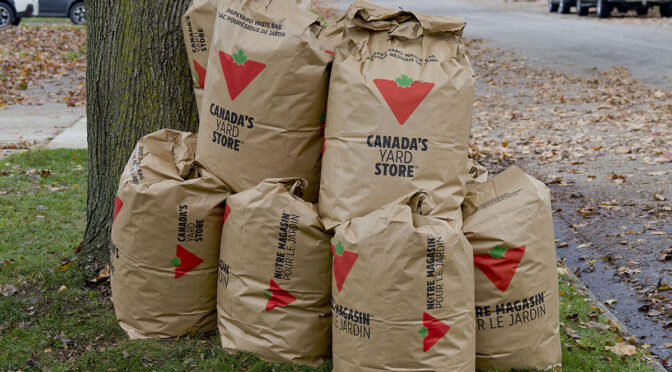
A few days ago while raking leaves I was reminded about the importance of making things easy. This simple reality can directly impact our approach to photography and how we buy camera gear.
NOTE: Click on images to enlarge. Photos have been added to serve as visual breaks. To view this article in a range of other languages click on the Canadian flag in the upper right corner.
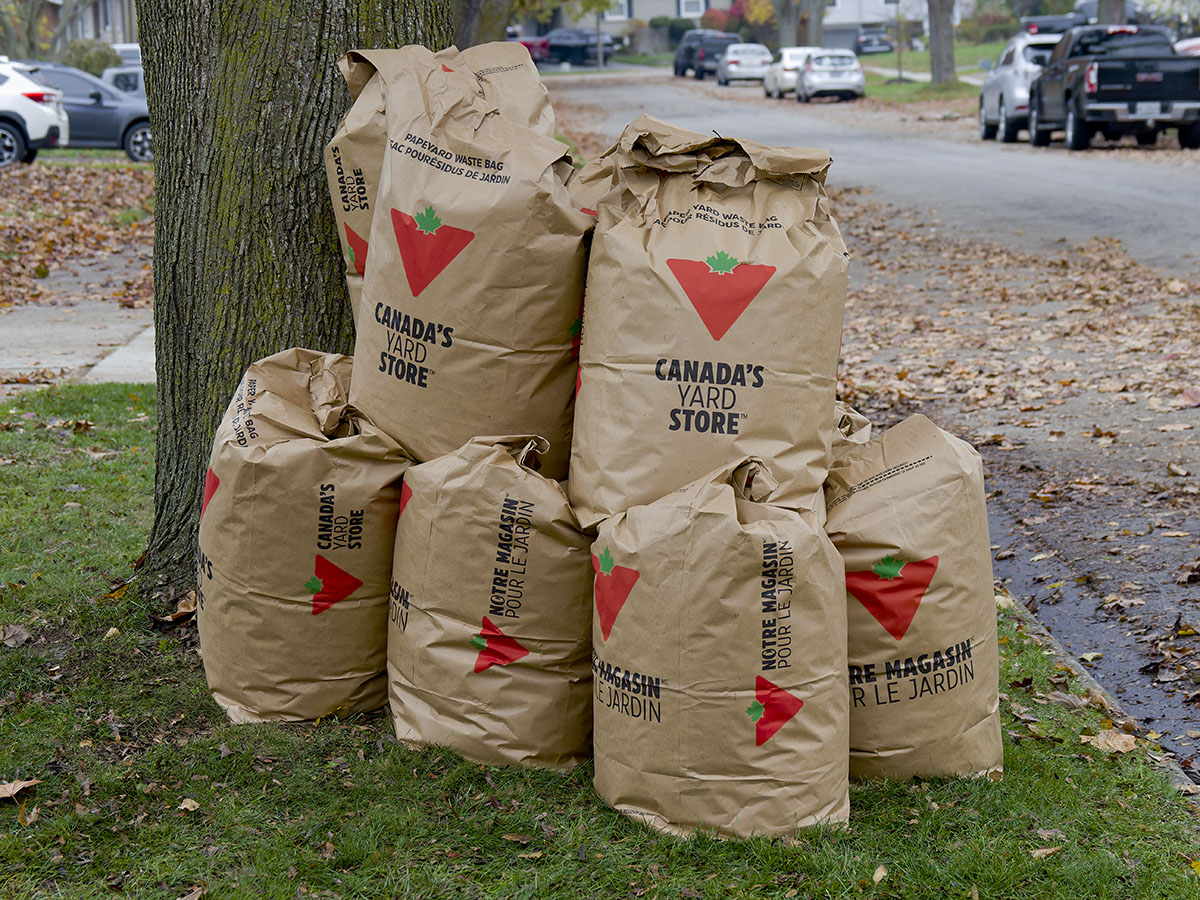
Raking leaves is a mundane task that many of us do every year. What made this fall different was how much easier it was for me. During my first round of leaf raking this season, I filled 10 large leaf bags. All of which had their contents firmly packed down.
I was surprised with how much faster and easier I was able to accomplish this task because of a couple of new rakes we bought. These new rakes, especially the red and silver one, made the task of raking leaves much more time efficient, and far less physically demanding.
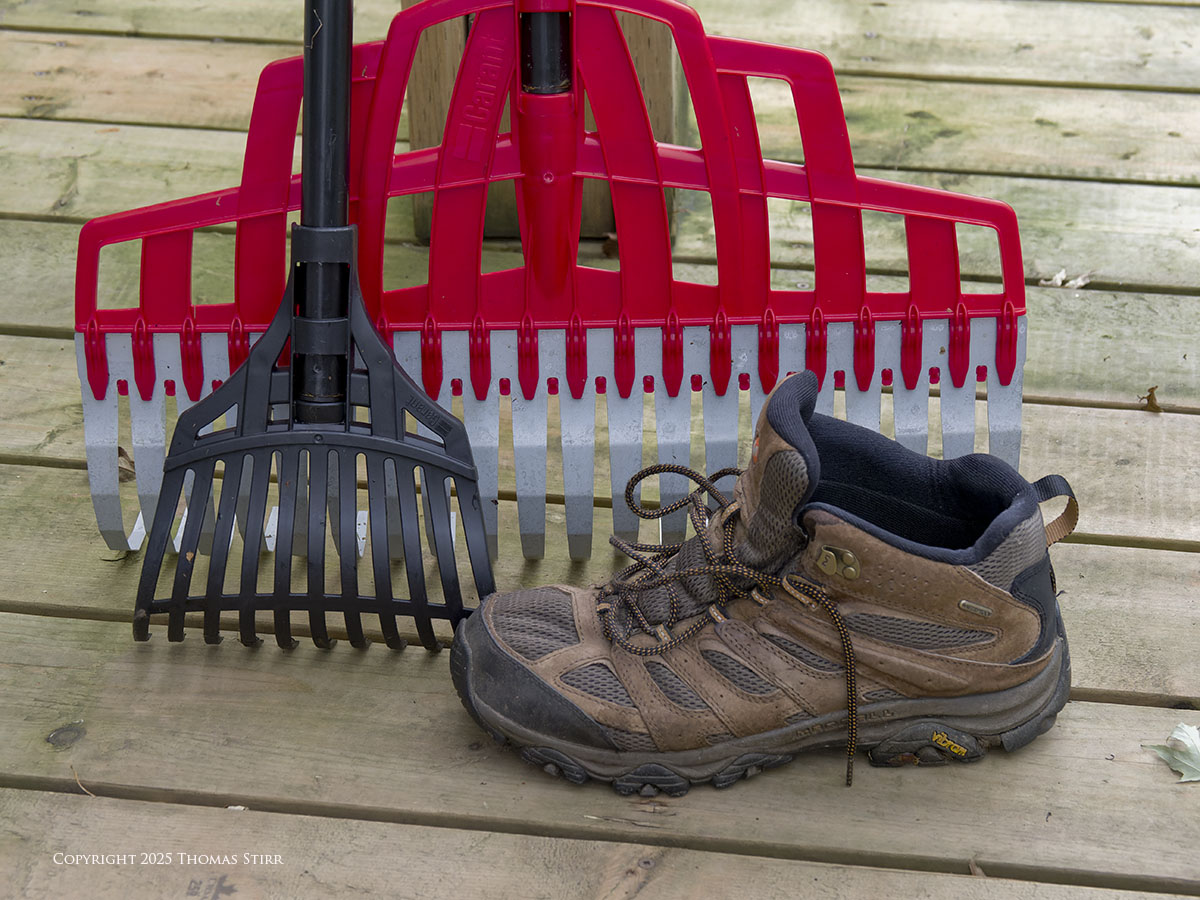
You can see the size of the rakes compared to my size 11 Merrell hiking boat. This is the smallest leaf rake that I’ve ever used. This begs the question how could it possibly be more time efficient and less physically demanding? The simple answer is its design.
The individual tines are thinner and much closer together when compared to other rakes I’ve used. This traps leaves much more effectively. Plus, the tines have a tall and significant inward curl. This allows a higher volume of leaves to collect under the head of the rake. These two design features changed the physical motion I needed to use to rake the lawn.
Rather than execute a typical series of hard, short, quick strokes over roughly the same area over and over again to gather leaves, I could simply put the rake on the surface of the grass and pull it towards me with one smooth stroke. It would collect the leaves and funnel them underneath the curved tines. For parts of the lawn where the leaf coverage wasn’t as thick, I could accomplish this task with basically one hand. I was impressed!
For me, making things easy has become the most critical consideration when buying camera equipment. Obviously we all face different challenges with the work we do. The camera gear that makes one photographer’s work easier to do… may not be the right gear for another photographer. But the fundamental need is the same.
We can end up chasing our tails by spending an inordinate amount of time comparing gear specifications. Worrying about sensor size. And spending hours reading/watching reviews.

We can get overloaded with a myriad of details and numbers… and miss the most important factor when buying camera gear by not asking ourselves a very simple question. Is this gear going to make doing my work easier?
If it doesn’t… there’s a good chance we’ll move on to something else in the not too distant future… with our wallets lighter in the process.

Like other folks I’ve made some mistakes when buying camera gear. A big one comes to mind. That mistake was ‘drinking the Kool-Aid’ when it came to full frame gear. I believed all of the hype and invested a fair amount of money (low five figures) in a reasonably extensive full frame kit.

No doubt the camera’s full frame sensor delivered great dynamic range and colour depth… as well as handling photographic noise quite well. The prime lenses and constant aperture f/4 zooms I owned were capable of good, sharp images. I could point my gear at just about anything and be assured of a solid, useable image.

But… that gear did not make doing my client video work easier. It added complexity and time to every project. Not only did I have to bring various tripods/fluid heads and typical camera supports like a slider, a jib, a skater dolly, and a stabilizer… I had to bring studio lights with me. Usually 4 or 6, along with light stands and a couple of hundred feet of extension cords. Onsite set-up wasn’t pretty. Other than pretty time consuming.

By accident, I stumbled into the Nikon 1 system as a back-up for my primary full frame kit. The Nikon 1 V2 turned out to be a wonderful little piece of kit for my industrial safety video work. Paired up with Nikon 1 prime lenses like the 10 mm f/2.8, 18.5 mm f/1.8 and 32 mm f/1.2 the Nikon 1 kit made shooting in poorly lit industrial venues much easier.
I could see a clear route to increased video project efficiency. All I had to do was cross the sensor size fixation bridge… and ignore all of the negative reviews that the Nikon 1 system had garnered.
Rather than have to set up a bank of studio lights for each video scene… then move them around constantly throughout the day… I could leave all of those lights at home and just shoot in available light.
Using shorter focal length Nikon 1 lenses with a crop factor of 2.7X meant I could get the depth-of-field I needed at f/2.8… rather than having to stop my full frame lenses down to f/8. The quality of the resulting video clips was more than acceptable to my clients.
Of course the Nikon 1 V2 wasn’t designed for prolonged and intensive video work, so the camera body was quite prone to overheating. The on-site time savings were so significant it made sense for me to buy two additional V2 bodies, and simply swap them out when they overheated… and keep shooting.

I did make another mistake buying camera gear, but it wasn’t as disruptive as my full frame adventure. That was dabbling with a pro level body and a couple of f/2.8 pro zoom lenses with a different M4/3 manufacturer. Once again I had made the mistake of believing reviews that I had read.
Unfortunately, that gear made my work more difficult. The wide angle zoom was prone to flare… and the camera body’s auto-focus was simply unacceptable for photography… especially in lower light conditions. After 10 days I returned all of the equipment and paid a small restocking charge. I didn’t want to compound my frustration by holding onto that equipment… trying to make it work. A mistake is a mistake. It’s best to simply accept responsibility and move on.

My transition to the Olympus/OM system made my client work even easier than shooting with the Nikon 1 system. Not only did my studio lights stay at home… but so did all of my camera supports.
I could show up at a client video shoot with nothing more than a medium sized shoulder bag containing a couple of camera bodies and a few lenses… then shoot everything handheld because of the outstanding IBIS (in-body image stabilization) performance. Constant aperture f/2.8 PRO zooms were ideal for the lighting conditions I faced, and gave me far more on-site flexibility when compared to using primes.
My client video days are well behind me now… but my need for camera gear that makes my work easy to do remains. Using technologies like Pro Capture, Bird Detection Subject Tracking, LiveND, in-camera focus stacking, and Handheld Hi Res are liberating. The excellent weather sealing eliminates stress and extends my photographic potential. Making things easy has become an everyday occurrence that I cherish.

At the end of the day it doesn’t matter what each of us uses in terms of camera equipment. Camera sensor size. Make. Model. None of that matters at all… as long as what we use is making things easy.
Technical Note
Photographs were captured handheld using camera gear as noted in the EXIF data. All images were created from RAW files and out-of-camera jpeg files using my standard process in post. This is the 1,493 article published on this website since its original inception in 2015.
How you can keep this website advertising free
My intent is to keep this photography blog advertising free. If you enjoyed this article and/or my website and would like to support my work, you can purchase an eBook, or make a donation through PayPal (see Donate box below). Both are most appreciated.

You may enjoy bird photography, and if so our 188 page eBook Handheld Bird Photography may be of interest. It is available for download for an investment of $14.99 CDN. The best viewing experience of this eBook will be at 100% using Adobe Acrobat Reader.
Sometimes all we need as photographers is a bit of inspiration. We hope you can find some of that inside Finding Visual Expression II.

Finding Visual Expression II is available for download for an investment of $11.99 CDN. The best viewing experience of this eBook will be at 100% using Adobe Acrobat Reader.
You may be interested in all of the 30 concepts covered in both of these related eBooks. If so, you may want to also consider Finding Visual Expression.

Finding Visual Expression is available for download for an investment of $11.99 Cdn. The best viewing experience of this eBook will be at 100% using Adobe Acrobat Reader.
Our other eBooks include Images of Ireland, New Zealand Tip-to-Tip, Nikon 1: The Little Camera That Could, Desert & Mountain Memories, Images of Greece, Nova Scotia Photography Tour, and a business leadership parable… Balancing Eggs.
If you click on the Donate button below you will find that there are three donation options: $7.50, $10.00 and $20.00. All are in Canadian funds. Plus, you can choose a different amount if you want. You can also increase your donation amount to help offset our costs associated with accepting your donation through PayPal. An ongoing, monthly contribution to support our work can also be done through the PayPal Donate button below.
You can make your donation through your PayPal account, or by using a number of credit card options.
Word of mouth is the best form of endorsement. If you like our website please let your friends and associates know about our work. Linking to this site or to specific articles is allowed with proper acknowledgement. Reproducing articles, or any of the images contained in them, on another website or in any social media posting is a Copyright infringement.
Article is Copyright 2025 Thomas Stirr. Images are Copyright 2013-2025 Thomas Stirr. All rights reserved. No use, duplication or adaptation of any kind is allowed without written consent. If you see this article reproduced anywhere else it is an unauthorized and illegal use. Posting comments on offending websites and calling out individuals who steal intellectual property is always appreciated!
Thanks for another great article, Thomas. Thanks to you I took a Nikon 1 kit to Nova Scotia a few weeks ago and never before had so much enjoyment from a camera. I’m a camera junkie and shoot with Olympus, Leica, Fuji X and GFX cameras. The OM System (and Olympus) are my work horses for macro and wildlife, but for travel nothing comes close to the Nikon 1 system. I’m now in the process of converting a Nikon 1 J3 to full spectrum for shirt-pocket black and white infrared.
Hi Jim,
I agree that the Nikon 1 system is fantastic for travel… small, light and very capable! I’m glad you had a chance to visit Nova Scotia, it is a beautiful part of the country.
Tom
Thanks Tom. I have a suggestion for you—if you want to make things easy, stop raking your leaves! :). The local wildlife prefers it.
Our naturalizing journey began about 10 years ago with leaving the leaves on our suburban lawn—first the back then the front. Over time and with some thoughtful planting and some help from Carden Naturescaping here in Guelph, we have gradually turned our front and back yards into natural habitats with native species and a rain harvesting garden. It’s been a wonderful journey and I no longer have to mow or rake!
Cheers,
Terry
Hi Terry,
Depending on where one lives there may be some local bylaws that come into effect in terms of having one’s yard in a ‘natural’ state. Plus… I could never get my wife to agree!
Tom
Another interesting piece Tom, your journey from full frame to our wonderful sensor sized professional level EM1x was similar to mine. I started shooting wedding work with my Canon EOS 5D original and a plethora of L lenses I also still shoot with my original Fujifilm X100 Bayer sensor 12 MP. This little camera transformed my wedding work. It was the same resolution as the Canon I used. I went all in Fujifilm for weddings the smaller sensor was never discussed by my clients. I could easily shoot weddings with my EM1x and lenses – but my health won’t allow that. As I have said before my Olympus system meets everything I throw at it. Very happy with my choices
Hi Mark,
Thanks for sharing some of your photographic journey. Interesting that we have a kinship when it comes to the E-M1X.
Tom
I carry two Nikon 1 V2 bodies, one with the 10-100 zoom lens the other with the 70-300 zoom lens in a small fanny pack barely big enough to carry a Medium Thermos Bottle…and giving me a range from wide 27mm to telephoto 810mm….My Arms, Shoulders, and Back, Thank You Every Day !
Hi Dave,
The size and capability of Nikon 1 is wonderful.
When we travelled with it I use to take three Nikon 1 bodies, each fitted with a different zoom lens. In my case it was a J5 with 6.7-13, another J5 with the 10-100, and a V3 with the 70-300. My wife liked using a V3 as she liked the tilting screen. She has the 10-30 PD zoom on her camera. The photographic flexibility with the Nikon 1 system was fantastic for travel… and my three body/lens combination all fit in a medium sized shoulder bag.
Glad to hear that your V2’s are working well for you.
Tom